
Chemical waste collection for universities and research labs
A university's chemical waste problem is rarely one problem. There is the steady stream from teaching labs, the unpredictable output of research groups, and the store left behind when a principal investigator retires or a building is refurbished. The decision a lab manager or waste officer faces is how much of this can run on a schedule and how much needs to be handled as separate one-off work. Both need the same discipline of description and segregation. We arrange collections of laboratory chemicals through registered hazardous waste carriers and take care of the price, consignment notes and invoice. We do not transport or treat waste ourselves. Your institution remains the producer, with the duties that follow.
Request a quote
Tell us what you have. A rough list is fine. We reply within 2 working days.
What we handle from university laboratories
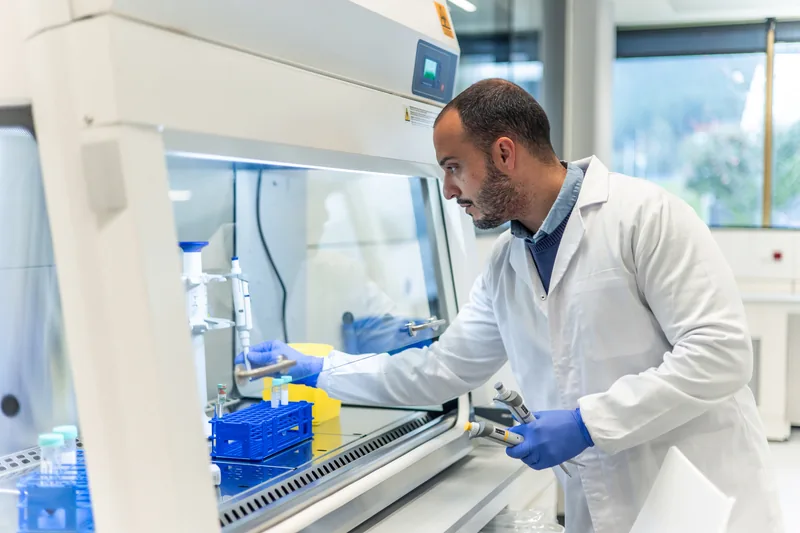
Teaching labs produce relatively predictable waste: aqueous metal residues, used organic solvents, and reagents past their useful life. Research groups are another matter. We expect small quantities of a very wide range of chemicals, with an uneven quality of labelling. These are the stocks that come up most often:
- halogenated and non-halogenated solvent waste, from synthesis and from HPLC
- expired and surplus reagents, including part-used containers of fine chemicals
- deuterated solvents and NMR tube residues
- molecular biology reagents such as phenol and chloroform mixtures, acrylamide and ethidium bromide
- fixatives and stains from microscopy, with osmium tetroxide kept apart
- peroxide-forming solvents such as tetrahydrofuran and ethers, with their dates
Radiochemicals and uranium compounds, explosives and anything flagged as unstable, gas cylinders, asbestos and controlled drugs are handled as a manual enquiry and do not join a routine collection. That includes the lecture bottle at the back of a fume cupboard, and pharmacology departments' licensed drugs.
How collection works
-
List
Send a stock list, a spreadsheet or a few photos. A rough list is fine, and we will ask about anything unclear.
-
Price
We work out how the items will be packed and give you one price, with the waste code for each line.
-
Book
Accept the quote against a purchase order and we agree a date that suits the site.
-
Collect
A registered carrier packs the chemicals on site and takes them away for treatment or disposal.
-
Document
You get the consignment note and disposal records. Keep them for at least three years.
What to have ready for a university collection
- the building, room and research group for each stock list
- a chemical name, quantity and container type for each line, with concentration if it is a solution
- the composition log for every mixed waste bottle
- a named person who knows the work, for each unidentified item
- access details such as permits, fume cupboard isolation and goods lift bookings
- the department's cost code and purchase order route
A list of two thousand lines does not worry us if the columns are honest. A list of forty lines with half of them marked unknown takes longer, and we would rather know that at the start.
Lab moves, retirements and legacy stock
The hardest university jobs follow a departure. A research group closes, the students who made the samples have gone, and a technician is left with a walk-in cold room and three fume cupboards. Before anything is listed, ask the person leaving to walk the space with you and identify what they can. A day of their time is worth more than any later analysis.
Pyrophoric reagents deserve particular care in this situation. An old bottle of n-butyllithium or a tin of sodium hydride can be more dangerous after years of storage, and an abandoned solvent still may hold residues that have concentrated. Do not move this material or clean out the equipment yourself. Treat it as a matter for chemical store assessment.
Freezers and fridges hold more than people remember. Thawed stocks, failed seals and labels written in solvent-soluble ink are common, and a defrost can turn a small identification problem into a large one. Keep them running until the contents have been looked at.
Samples without a safety data sheet
Research compounds often have no safety data sheet, and a CAS number may not exist. That does not take them out of the waste controls. The technical guidance on waste, known as WM3, is direct about this: where the composition of a mirror entry waste is not known and genuinely cannot be determined, it must be classified under the hazardous entry, and direct testing cannot prove an unknown waste is non-hazardous.
What helps is context. A group that can say that a set of vials are substituted aromatic amines, in the region of 50mg each, has given a chemist something to work with. A shared drive of lab notebooks is more useful here than any label. WM3 also confirms that a crate of three laboratory chemicals is three separate wastes, each assessed in its own right, so a box labelled miscellaneous does not describe anything.
Principal investigators, departments and procurement
Universities hold responsibility centrally but keep knowledge locally. The institution is the producer, yet only a postdoc knows what is in the unlabelled carboy. The arrangement that works best keeps a named person for each research group, a named waste officer for the department, and one job file. Part B of the consignment note needs the SIC code of the process, along with a full description and the components, so that chain of knowledge is what fills it in.
Costs can be split by department or grant if you tell us beforehand. Many institutions put laboratory waste to tender as its own lot, usually called lab smalls in the UK trade. We can price against a defined schedule of work, invoice to a purchase order and accept payment by BACS, but you will need to confirm procurement requirements with your own team. Spin-out companies and tenants in a science park should normally be treated as separate producers, because a different legal entity is creating the waste.
Laboratory segregation at research scale
The rule that surprises most researchers is that using the same waste code does not make two wastes mixable. GOV.UK guidance says an acid and an alkali are different categories even when both sit under 16 05 06*. Mixing is also ruled out where it removes a recovery option or hides a component from the people downstream.
Waste bottles are where the serious accidents occur. Nitric acid added to a bottle containing organic solvent can pressurise and burst it hours later. Chloroform and acetone can react strongly in the presence of base. Each lab should have clearly separated waste containers, with vented caps where the risk assessment calls for them, and a log on every one. Flammable storage also has to fit the Dangerous Substances and Explosive Atmospheres Regulations, known as DSEAR, which is another reason not to let waste accumulate in the lab.
Animal and clinical research adds another layer. HTM 07-01 places research labs producing under 5 tonnes of healthcare waste a year on a two-yearly cycle for pre-acceptance audits. Biological waste with chemical contamination has its own route, covered on our clinical and laboratory waste page.
Changes coming for carriers and brokers
The rules for moving waste in England are changing, and it is sensible for a waste officer to track them. Digital waste tracking has been mandatory for receiving site operators in England and Wales since 1 October 2026, and government plans extend it to waste collectors, including carriers and brokers, from October 2027. Separately, Defra has announced that the registration system for waste carriers, brokers and dealers will move to a permit-based system in England during 2027. Until those changes take effect, the current duties remain as they are, including consignment notes and registration checks.
Related chemicals
Search the chemical database- TetrahydrofuranCAS 109-99-9Flammable


- AcetonitrileCAS 75-05-8Flammable
- DichloromethaneCAS 75-09-2Toxic
- n-ButyllithiumCAS 109-72-8Flammable

- Sodium hydrideCAS 7646-69-7Flammable
- Osmium tetroxideCAS 20816-12-0Toxic

- Ethidium bromideCAS 1239-45-8Toxic
- AcrylamideCAS 79-06-1Toxic
Frequently asked questions
How do you classify a compound synthesised in our own lab?
It starts with what the research group knows: the reaction, the starting materials, the likely product and any hazard data for related compounds. Where composition genuinely cannot be determined, the technical guidance on waste requires a mirror entry waste to be treated as hazardous. A named contact in the group is far more useful than a label reading sample 14B.
Can a principal investigator arrange a collection directly?
That is a matter for your university. Many institutions route all hazardous waste through a safety or estates office, because the university as a legal entity carries the producer's duties. We can work with either arrangement as long as one person holds the job file.
Do research students' mixed waste bottles need to be listed individually?
They need to be described by what is in them. A bottle labelled organic waste is not enough for a consignment note, which requires the components and their concentrations. A running log kept beside the bottle, and added to whenever anything goes in, is the usual answer.
What about spin-out companies in university buildings?
A separate company is normally a separate waste producer, even in a university building. It should have its own note, with its own name on it. Sort this out with your estates team before the collection is planned, rather than on the day.
Are radiochemicals included in a laboratory clearance?
No. Radioactive materials are handled as a manual enquiry, separately from the chemical collection. Flag any labelled compounds or uranyl salts on the list, because they are easily missed in an old freezer or a microscopy store.
Official sources
- GOV.UK: Waste classification technical guidance (WM3)
- GOV.UK: Hazardous waste consignment note guidance
- GOV.UK: Hazardous waste segregation and mixing
- GOV.UK: Developing the digital waste tracking service
- GOV.UK: New reforms to stop waste criminals from exploiting loopholes
- NHS England: HTM 07-01, safe and sustainable management of healthcare waste
- HSE: Dangerous Substances and Explosive Atmospheres Regulations
Send us your list
A rough list or a photo of the shelf is enough for us to start. We reply within 2 working days.
Latest articles
All guides and articles-
What to do with unlabelled bottles in a lab
Do not open or move them. How to make an unlabelled bottle safe to leave, what to record and how identification works.
-
What counts as hazardous waste in a school or lab
Which lab and school waste is hazardous, how to tell, and what the law expects you to do before anything leaves site.
-
How to keep a chemical inventory in a science department
What to record for each container, how to set up locations and how to keep a school chemical register current.