
Laboratory chemical disposal
Laboratory chemicals rarely fit a normal waste collection, because the job is many small containers of very different things. The decision for a technician, lab manager or waste officer is how to get this stock off site legally and safely, and what information is needed first. Mostly, the answer is a chemist-packed collection in lab packs, working from a stock list. Lab Chemical Disposal is owned by Box 4 Digital Group Ltd. We arrange these collections through registered hazardous waste carriers and handle the price, the paperwork and the invoice. We do not transport or treat waste ourselves. Responsibility for describing your waste accurately stays with you as the producer, and the carrier and receiving site carry their own duties alongside yours.
Request a quote
Tell us what you have. A rough list is fine. We reply within 2 working days.
What we handle in a laboratory chemical collection
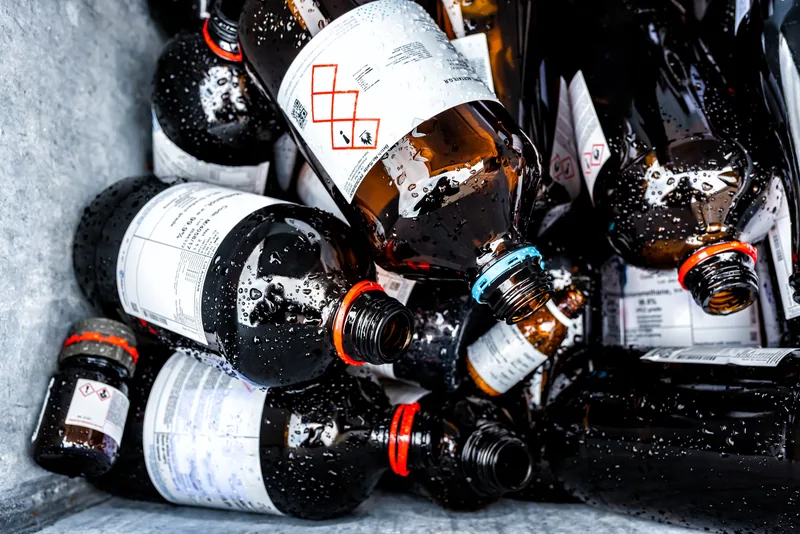
Almost anything a working laboratory holds in small containers can be priced from a list. That covers surplus and expired reagents, teaching solutions, organic and inorganic chemicals, stains and indicators, solvents and spent method waste. Schools send long lists of small bottles, research groups send unusual compounds in tiny quantities, and hospital laboratories send regular fixative and solvent streams.
Five groups do not follow that route: controlled drugs, radioactive sources, explosives (including dried picric acid and other chemicals flagged as unstable), compressed gas cylinders and asbestos. They go to a manual enquiry, usually together with a recommendation for a chemical store assessment. Unknown substances that cannot be placed with confidence join them. Nothing about this is unusual. These items simply need someone's judgement before any price is meaningful.
How collection works
-
List
Send a stock list, a spreadsheet or a few photos. A rough list is fine, and we will ask about anything unclear.
-
Price
We work out how the items will be packed and give you one price, with the waste code for each line.
-
Book
Accept the quote against a purchase order and we agree a date that suits the site.
-
Collect
A registered carrier packs the chemicals on site and takes them away for treatment or disposal.
-
Document
You get the consignment note and disposal records. Keep them for at least three years.
What to have ready for a laboratory collection
- chemical names, with CAS numbers if you have them
- quantity and container size per line, and number of containers
- concentration, for anything in solution
- condition notes, such as a seized cap, leakage, crystals or a damaged label
- a list of anything that may need a manual enquiry, kept separate
- site access, parking and working-hours restrictions
- the name of the person who will sign the consignment note
A spreadsheet is ideal, but a handwritten stock book is enough to start, and the first conversation usually shows whether a site visit is needed before any bottles move.
How lab packs work
A lab pack is a common way of moving small chemical containers. Bottles of compatible chemicals are placed inside an outer drum or box that is approved for transporting dangerous goods. Absorbent, cushioning material fills the gaps, so a broken inner bottle stays contained and does not move around. The drum is labelled, sealed and described on the transport paperwork.
The compatibility step is what makes the job skilled work. A chemist, usually working from your list and then checking each bottle, sorts stock by transport class and chemical reactivity. GOV.UK's guide to moving dangerous goods lists these classes, including flammable liquids, oxidising substances, toxic substances and corrosives, and puts responsibility on the consignor or sender to classify, package and mark them. Oxidisers do not go with organics. Acids do not go with alkalis or cyanides. Water-reactive chemicals go somewhere dry and apart.
This is also the reason a small list can produce several drums. Fifty bottles may need five packs if they span five hazard groups, and four of those packs may be only partly full. Weight does not drive the cost the way people expect. The number of incompatible groups often matters more.
Packing normally happens on your site, at a bench or a clear floor area. Permitted facilities are also told to sort and segregate laboratory smalls at source wherever possible, so that containers do not need to be reopened or re-sorted later.
Why segregation matters before anyone arrives
Keeping things apart is both a chemical precaution and a legal requirement. GOV.UK states that hazardous waste must not be mixed with non-hazardous waste, with non-waste, or with other categories of hazardous waste. Categories are defined by what would happen if you mixed them, and not by the code. Its own example is telling: an acid and an alkali are different categories even when both carry 16 05 06*.
Mixing also includes dilution. A mixture that reduces a hazardous property by dilution, removes a recovery option, or hides a component from the next holder is the wrong side of the line. It does not matter how tidy the result looks. Bottles sitting in the same crate are a different matter, provided they are not physically mixed, cross-contamination cannot occur and each is separately described, because the guidance treats that as co-collection.
WM3, the technical guidance on waste, uses this very situation as an example. A crate containing bottles of three different laboratory chemicals holds three wastes, each assessed separately.
Waste codes by type of laboratory
Six-digit List of Waste codes, also called EWC codes, depend on where the waste came from as well as what it is. A school or university preparation lab commonly uses 16 05 06* for laboratory chemicals containing hazardous substances. A hospital lab has chapter 18 to look at first, with 18 01 06* for hazardous chemicals. A veterinary lab looks at 18 02 05*. Photochemicals sit in chapter 09 wherever they come from. Collected solvents usually fall under 14 06 02* or 14 06 03*.
The asterisk marks a hazardous entry. Where there is a choice between a hazardous and a non-hazardous entry for the same material, you must assess it, and WM3 says that waste with a mirror entry whose composition genuinely cannot be established takes the hazardous entry. A safety data sheet helps, but only for the chemical as supplied, and it says little about a working solution that has been used and contaminated.
What makes a chemical list possible to price
A good list answers the questions a chemist would ask on the phone. What is it? How much? What is it in, and what state is it in? Rows that answer those four questions can be priced almost immediately.
The problems come from vagueness that hides risk. Mixed chemicals is not a description. Solvents could mean ten litres of acetone or ten litres of chloroform and acetone together, which are very different jobs. A note that a bottle has crystals round the neck changes everything about how it is handled, and we would far rather have it than a clean-looking list that leaves it out.
Unidentified bottles do not stop a list being priced. They are priced differently, once someone has seen them, and they do not hold up the known stock if they can be kept apart.
Paperwork and the producer's duties
In England, you must classify your waste, store it safely, use authorised businesses, complete your parts of the consignment note and keep your records for three years at the premises. We prepare the paperwork and send it for your check, but the description is yours. The duty of care code of practice defines a broker as someone who arranges the transport and management of waste on behalf of another party, and it makes clear that using one does not remove your own duties.
Wales has its own consignment code format and registration of premises above 500kg a year. Scotland uses a special waste consignment note with a code issued by SEPA. Northern Ireland has its own system, and collections there are a manual enquiry for now.
Changes to waste rules in 2026 and 2027
Two reforms are worth knowing about, though neither changes your duties as a producer today. Digital waste tracking has been mandatory for receiving site operators in England and Wales since 1 October 2026. Government plans extend it to Scotland and Northern Ireland from January 2027, and to waste collectors from October 2027. Defra has also announced that the registration system for carriers, brokers and dealers will move to permits during 2027. Consignment notes remain in use in the meantime.
Related chemicals
Search the chemical database





Frequently asked questions
What is the difference between a lab pack and lab smalls?
Lab smalls is the UK trade term for the small containers of chemicals a laboratory holds. A lab pack is how they travel: a transport-approved outer container holding compatible inner bottles, cushioned with absorbent material. The two terms are often used interchangeably.
Does each bottle need its own waste code?
Each different chemical is assessed as a separate waste. Several may share a code, such as 16 05 06*, but they still need separate description, and the note has to show the components. That is why a list by line works better than a total weight.
Who is legally responsible once a carrier has taken the waste?
The duty of care applies to everyone in the chain, including you as producer. Handing the waste over does not end it. You need to check that it is going to an authorised person, describe it accurately and keep your copy of the paperwork.
Are you a waste carrier?
No. We arrange the collection and deal with the price, paperwork and invoice. A registered hazardous waste carrier collects the waste, and its details appear on the consignment note along with those of the site that receives it.
Can we send a list with only names and no quantities?
Yes, as a start. Quantities and container counts will be needed before a price can be firm, since they decide the number of lab packs. Rough counts are fine, and a chemist will confirm the real figures at packing.
What happens if a bottle on the day does not match the list?
It is noted and dealt with on the day where that is safe, or set aside if it is not. A substance that turns out to be unstable or unidentifiable will not be packed just to finish a job. It will go back to you as a manual enquiry.
Official sources
- GOV.UK: Hazardous waste, overview for England
- GOV.UK: Hazardous waste segregation and mixing
- GOV.UK: Waste classification technical guidance (WM3)
- GOV.UK: Chemical waste, appropriate measures for permitted facilities
- GOV.UK: Moving dangerous goods
- GOV.UK: Waste duty of care code of practice
- GOV.UK: Developing the digital waste tracking service
- GOV.UK: New reforms to stop waste criminals from exploiting loopholes
- Natural Resources Wales: How to complete a hazardous waste consignment note
- SEPA: Special waste consignment note
- DAERA: Hazardous waste in Northern Ireland
Send us your list
A rough list or a photo of the shelf is enough for us to start. We reply within 2 working days.
Latest articles
All guides and articles-
What to do with unlabelled bottles in a lab
Do not open or move them. How to make an unlabelled bottle safe to leave, what to record and how identification works.
-
What counts as hazardous waste in a school or lab
Which lab and school waste is hazardous, how to tell, and what the law expects you to do before anything leaves site.
-
How to keep a chemical inventory in a science department
What to record for each container, how to set up locations and how to keep a school chemical register current.