
Chemical store assessment
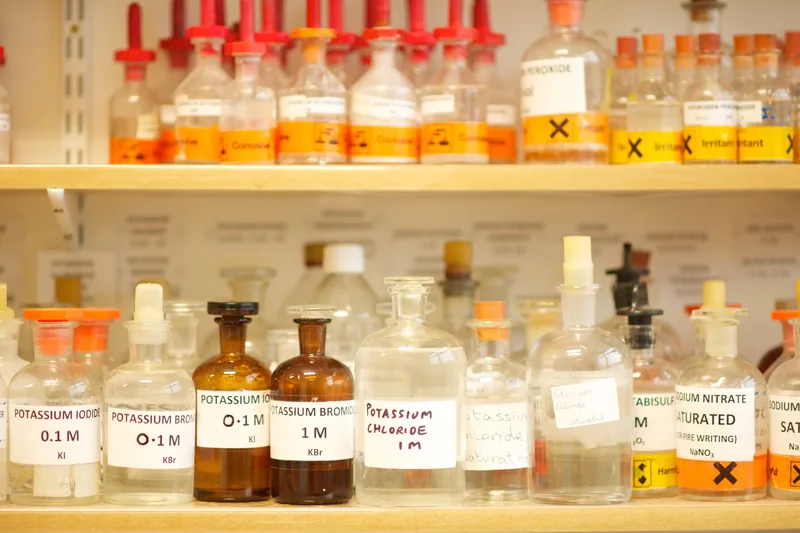
Some stores should not start with a stock list, because compiling one means handling things that ought not to be handled. If you have inherited a store with unlabelled bottles, very old containers or stock you are uneasy about, the decision is whether to get a chemist's view before anything is touched. A chemical store assessment gives you that view: a visit, a risk-ranked record of the stock, and a plan you can put in front of your head, manager or safety lead. We arrange the visit with a chemist from a registered hazardous waste carrier and handle the price and invoice. We do not transport or treat waste ourselves, and your employer keeps its own legal duties.
Request a quote
Tell us what you have. A rough list is fine. We reply within 2 working days.
How collection works
-
List
Send a stock list, a spreadsheet or a few photos. A rough list is fine, and we will ask about anything unclear.
-
Price
We work out how the items will be packed and give you one price, with the waste code for each line.
-
Book
Accept the quote against a purchase order and we agree a date that suits the site.
-
Collect
A registered carrier packs the chemicals on site and takes them away for treatment or disposal.
-
Document
You get the consignment note and disposal records. Keep them for at least three years.
How to prepare for a store assessment
Very little handling is needed, and we would prefer that you do none. Keep the store locked and do not reorganise it, because the arrangement itself is evidence. Find whatever paperwork exists, including old stock lists, purchase orders and notes from former staff. Also make sure you know who holds responsibility for the room, since that person should hear the chemist's findings directly.
If you have concerns about a specific item, mention them when arranging the visit. Say what it is, where it is and why you are concerned, and keep people away from that area. If you think there is an immediate danger, do not wait for a visit: follow the steps on our emergency chemical removal page.
What a chemical store assessment covers
The chemist works through the store systematically, shelf by shelf, looking at each container without treating or disturbing anything more than is needed. The visit is intended to answer five questions about your stock:
- what is here, as far as it can be established safely
- what state each container and closure is in
- what is stored next to what, and whether it should be
- which items present a risk now, and which can wait
- which items are still of use to you, and which should go
An assessment can include stock requiring specialist attention, such as dried picric acid and other potentially unstable chemicals. It can also record the presence of radioactive sources, explosives, gas cylinders, asbestos and controlled drugs, so that each can be dealt with through the right process. Recording an item does not mean it can be removed on the same visit.
When an assessment is a better first step than a collection
A routine collection suits a store where stock is mostly known and containers are sound. An assessment suits a store where those things are in doubt. These are situations where an assessment can be particularly useful:
A new technician starts and the previous one left no records. A school joins a trust, and the central team has no idea what its store holds. A hospital department or research group closes and leaves stock behind. A building survey or refurbishment opens up a locked cupboard. Or a stock check turns up something like an old tin of metal under evaporated oil, and nobody wants to be the person who moves it.
Age is a useful guide. Containers from before 1990 deserve more caution, since old closures can fail and old labels may use names and symbols nobody now recognises. If the only way to read a label is to pick up the bottle and turn it round, and the bottle looks doubtful, that is a sign the job should start with a chemist.
What the report contains
You should get something you can act on, not a general account of good practice. A sound report lists each container or group, with its location, its likely identity and how confident the chemist is about that. It records condition, and ranks each item by the urgency of the risk it presents. It flags incompatible storage, such as oxidisers near organics or acids beside cyanides. And it ends with a disposal list, with the items sorted into those that can be collected routinely and those needing special arrangements.
Risk ranking is where the chemist's judgement earns its fee. A shelf of old lead salts can usually wait for a planned collection, while one bottle of dried-out picric acid may need specialist attention before anything else happens in the room. A list that gives them equal weight is not useful to a business manager deciding where to start. Good reports separate problems of hazard from problems of tidiness, and they say which is which.
The disposal list can then be priced directly as a collection. A report written with collection in mind also reduces time on the packing day, since the difficult items have already been identified.
How an assessment fits with your legal duties
The Department for Education's guidance says schools should conduct regular audits, account for their chemicals at all times and have routine surveillance to confirm stock remains safe to store. It also says they should have access to professional advice, along with their own suitably trained staff. An assessment contributes to those expectations. It does not transfer them.
Outside education, the same logic applies under general duties. Under COSHH, employers identify hazardous substances, decide who might be harmed and how, and decide what further action is needed. DSEAR requires them to find out what dangerous substances are in the workplace and what the risks are. A report gives whoever carries out those assessments better information, but they still need to be done, and the employer stays responsible for them.
The report also helps with waste classification, since the chemist's view of a bottle's identity supports the description that later goes on a consignment note. Under WM3, waste with a mirror entry whose composition genuinely cannot be established takes the hazardous entry, so the more that can be identified, the fewer lines need that cautious treatment.
Security questions an assessment can raise
An old store may hold chemicals that nobody has thought about in security terms. Several common stock chemicals are on the Home Office list of explosives precursors and poisons, and businesses that use or hold them must report significant losses or thefts. If a store has no history, nobody can say whether anything is missing. A report gives you a dated baseline for the first time.
Any material that may be explosive is treated differently. HSE's explosives guidance applies, and the DfE notes that transport and disposal of desensitised explosives may need a classification or authorisation from HSE. A chemist who finds such an item will tell you what needs to happen next, and that may involve people other than the carrier.
What to have ready for a chemical store assessment
- the site address, and which rooms and cupboards are in scope
- approximate size of the store, by number of shelves or cabinets
- any existing stock lists, even if they are many years old
- what prompted the assessment, including specific concerns
- names of former staff who may remember the stock
- safeguarding, permit or induction requirements for visitors
- who will receive the report, and who has authority to approve what follows
Bear in mind that a store assessment produces findings you may need to act on, including ones you did not expect. It is worth deciding in advance who will make those decisions and where the budget will come from, so the report does not sit in a drawer once it arrives. Our annual stock check collection is one way of keeping a store in good order after that first look.
Related chemicals
Search the chemical database- Picric acidCAS 88-89-1Flammable



- 2,4-DinitrophenylhydrazineCAS 119-26-6Flammable

- Diethyl etherCAS 60-29-7Flammable
- TetrahydrofuranCAS 109-99-9Flammable
- Potassium metalCAS 7440-09-7Flammable

- Sodium metalCAS 7440-23-5Flammable
- BenzeneCAS 71-43-2Flammable
- White phosphorusCAS 12185-10-3Flammable
Frequently asked questions
Is a store assessment the same as a COSHH assessment?
No. A COSHH assessment looks at how your people are exposed to substances in your work, and it remains the employer's duty. A store assessment looks at the stock itself: what it is, what condition it is in and what should happen to it. The findings can inform your COSHH review, but they do not replace it.
Will the chemist remove anything during the visit?
An assessment and a collection are separate jobs, each with its own paperwork. The report comes first. If something on the day cannot safely wait, the chemist will tell you what immediate action is needed, including involving the emergency services where necessary.
Do we have to use the same carrier for the follow-up collection?
The report is yours to keep and act on as you see fit. If you ask us to, we can turn its disposal list into a priced collection, and the chemist's notes then carry through to the packing plan.
What qualifications should a chemist have?
Ask to see them. A good assessment needs competence in chemistry and hazardous waste, and familiarity with transport classification. Your own competent person remains responsible for the decisions that follow, and should be involved from the start.
How often should a store be assessed?
There is no fixed interval in law, and a store with an accurate stock list and regular checks may only need it once. Common triggers are a change of technician, a merger or building move, or stock checks that keep finding things nobody can explain.
Official sources
- Department for Education: Storing and disposing of hazardous chemicals in schools
- HSE: How to carry out a COSHH risk assessment
- HSE: Dangerous Substances and Explosive Atmospheres Regulations
- GOV.UK: Waste classification technical guidance (WM3)
- Home Office: List of explosives precursors and poisons
- HSE: Explosives
Send us your list
A rough list or a photo of the shelf is enough for us to start. We reply within 2 working days.
Latest articles
All guides and articles-
What to do with unlabelled bottles in a lab
Do not open or move them. How to make an unlabelled bottle safe to leave, what to record and how identification works.
-
What counts as hazardous waste in a school or lab
Which lab and school waste is hazardous, how to tell, and what the law expects you to do before anything leaves site.
-
How to keep a chemical inventory in a science department
What to record for each container, how to set up locations and how to keep a school chemical register current.