
School chemical clearance
A clearance usually starts when someone has finally had enough of the back shelf, or when a new technician inherits a store they did not build. Your decision is what should go, what should stay, and what should not be touched before a chemist has seen it. This page is about a one-visit job from a technician's point of view: how to prepare the list, what to leave alone and what the visit involves. We arrange the collection through a registered hazardous waste carrier and handle the price, paperwork and invoice. We do not transport or treat waste ourselves. A member of your staff stays involved throughout, because the school is the waste producer and someone needs to sign for what leaves.
Request a quote
Tell us what you have. A rough list is fine. We reply within 2 working days.
How collection works
-
List
Send a stock list, a spreadsheet or a few photos. A rough list is fine, and we will ask about anything unclear.
-
Price
We work out how the items will be packed and give you one price, with the waste code for each line.
-
Book
Accept the quote against a purchase order and we agree a date that suits the site.
-
Collect
A registered carrier packs the chemicals on site and takes them away for treatment or disposal.
-
Document
You get the consignment note and disposal records. Keep them for at least three years.
What to have ready for a clearance visit
- the marked-up stock list, with a copy for the chemist
- your list of concerns and unidentified items, with locations
- keys, and a named person holding them for the whole visit
- the site's contractor sign-in and safeguarding procedure
- vehicle access details, including gate times and height limits
- the school's legal name and address, as it should appear on the note
What a school chemical clearance can include
A clearance suits a store that has built up over years, where most of the stock is known and a good part of it is no longer needed. It generally covers:
- solid chemicals in original containers, opened or unopened
- bench solutions, indicators and stains that have outlived their courses
- organic reagents kept for practicals that are no longer taught
- old biology and food test reagents
- concentrated acids, ammonia and alkalis you no longer want to hold
- mercury thermometers and similar sealed items
Some things do not go on a clearance list. Controlled drugs, radioactive sources, explosives, gas cylinders and asbestos each go to a manual enquiry. So does any chemical showing signs of instability.
What to list before a clearance
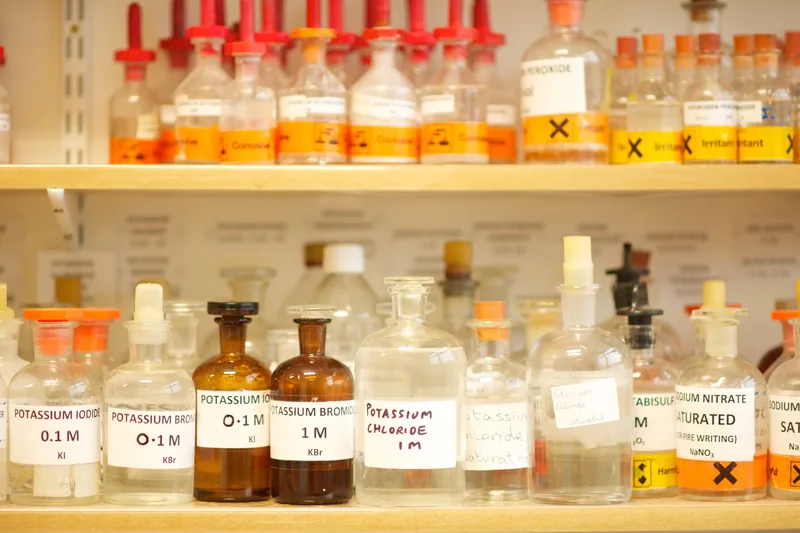
Work shelf by shelf, in the order the store is laid out. It makes the list easier to check on the day and means the chemist can walk straight to a bottle you have flagged. For each container, you need its name, the rough quantity remaining and the size of the container. Note any concentration on solutions. If your school already keeps a stock list, print it, mark the disposal items and add what you find that is missing from it.
Be strict about what you still want. A useful test is whether the chemical appears in a practical you expect to run within the next two years. Ask the teachers once, give them a date, and then close the question. Otherwise the list keeps changing until the morning of the visit.
Separate three kinds of entry as you go: known stock to clear, known stock with a concern, and anything you cannot identify. A bottle labelled in faded pencil is the third kind, even if you have a good idea what it is. A guess written as fact on a list can follow that bottle all the way through to a consignment note.
What to leave alone
Preparation for a clearance is a matter of looking, not handling. Do not open bottles to check what is inside, sniff them or try to read a label by wiping it with solvent. Do not consolidate half-empty containers, because that creates a mixture nobody can describe. And please do not try to treat, neutralise or dilute anything to make it easier to send.
Some containers should stay exactly where they are, and you should tell us about them before anything else happens. Examples include picric acid or 2,4-DNPH that may have dried out, ether or other solvents with crystals around the cap, and alkali metals whose oil has gone or whose surface has crusted. The same goes for a bottle with a bulging lid, a badly corroded closure or a screw cap that has seized. Write down the shelf and the bottle's description, take a photograph from where you stand if you can do so without disturbing it, and keep the store locked. These items usually need a chemical store assessment first.
If you see an immediate danger, such as a leak or fumes, or a container you believe could ignite or explode, get people out and follow our emergency guidance.
What happens on the day of the clearance
The visit usually begins with a walk through the store with your technician. The specialist compares the shelves with the list, looks at the flagged items and agrees a packing area. A clear bench, or some floor space near the store, is ideal. Keep a route to the door free, and let your site team know a vehicle is coming.
Packing is the slow part. Each bottle is normally checked, its closure looked at and its class confirmed, then it goes into a lab pack with compatible stock and absorbent material. Weights are recorded as the packs are built. A bottle that is not what the list says will be raised with you on the spot. Expect a few changes between list and final count, because a long list is never quite right.
Then comes the paperwork. The carrier and chemist will need Parts A and B of the consignment note completed and accurate. We prepare these in advance, and the final quantities are confirmed on the day. Part C is the carrier's, and Part D is signed by the consignor who is handing over the waste, normally a member of staff. Read it before you sign, and keep your copy.
What you hold after a clearance
You should end the visit with an updated picture of the store, along with your copy of the note. In England, the consignee return follows after the receiving site has dealt with the waste, on a quarterly cycle. If it has not reached you by the following quarter, ask for it in writing, as GOV.UK advises.
Now is the time to update your stock list, since a store is never as easy to count as it is on the day after a clearance. The DfE guidance for schools expects an up-to-date inventory, and the fire service will want to see one if it ever attends. Also review your COSHH assessments, because removing a group of chemicals can make some of them out of date.
Think about what you might do differently when ordering, too. Most prep rooms contain stock bought in a pack size far larger than a school could ever use. Smaller pack sizes cost more per gram, but they cost less to dispose of.
Timing a school clearance
School holidays and inset days work best for most departments, because there is no risk of pupils in the corridors and the technician can focus on one job. A visit during term is possible, but it needs a store with direct access or a route that avoids changeovers. Allow time for the school's own processes. A purchase order or a contractor sign-in procedure can take longer than the visit itself. You are also entitled to check the carrier's registration, and we would encourage you to do it.
A minimum order value applies to collections. A very small list may be better held until your next stock check, provided it is stable and known. The annual stock check collection suits a store that has been cleared once and needs keeping on top of.
Related chemicals
Search the chemical database




Frequently asked questions
How much of the day will a clearance take up for the technician?
That depends on the size of the list, so we would rather not give a fixed figure. Plan for a member of staff to be available from arrival through to signing, even if they are not needed all the time. Questions about individual bottles come up throughout the visit.
Will a clearance leave the store empty?
Only if that is what you asked for. A clearance removes what is on the agreed list. Stock you are keeping stays where it is, and we suggest marking it clearly so that nothing is added by mistake.
Can we add a few bottles found the night before?
Tell us as soon as you find them. Compatible, identified items can often be added if the packs have room. An unidentified or unstable find may need separate handling, and the specialist on site makes that call on the day.
What record do we get for governors or the head?
You get a list of what was removed, your copy of the consignment note, and later the consignee return. Together, they show what left, who carried it and where it went. In England, the school keeps them for three years.
What if our list is too small for a collection?
A minimum order value applies. If your list falls short, you can add more items or hold it until your next stock check. A secure store with an accurate list is a perfectly reasonable place for stable, identified waste to wait.
Official sources
Send us your list
A rough list or a photo of the shelf is enough for us to start. We reply within 2 working days.
Latest articles
All guides and articles-
What to do with unlabelled bottles in a lab
Do not open or move them. How to make an unlabelled bottle safe to leave, what to record and how identification works.
-
What counts as hazardous waste in a school or lab
Which lab and school waste is hazardous, how to tell, and what the law expects you to do before anything leaves site.
-
How to keep a chemical inventory in a science department
What to record for each container, how to set up locations and how to keep a school chemical register current.