
Expired and unlabelled chemical disposal
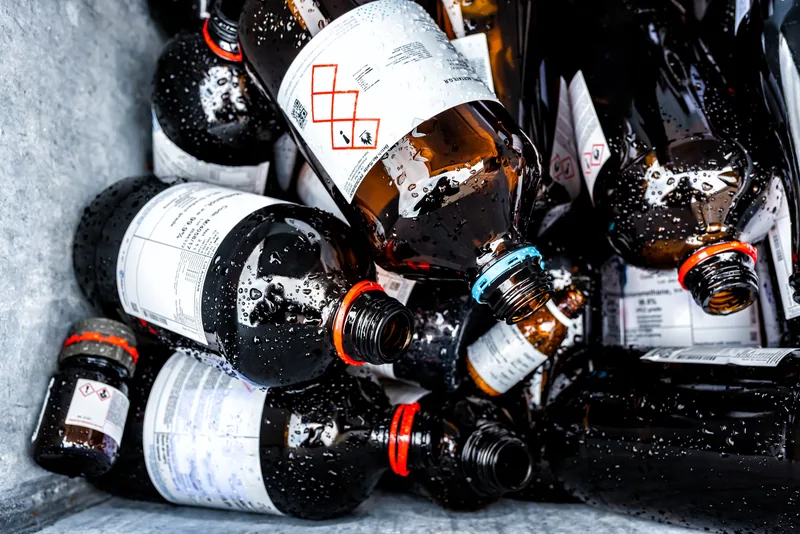
Finding a bottle with a date from another decade, or no label at all, raises a simple question: what do I do now? For a technician, lab manager or ward pharmacist, the decision is whether a container is simply past its best or is something that should not be disturbed. The date tells you little. The state of the container tells you more, and the history of the store tells you most. We arrange collections of expired and unknown chemicals through registered hazardous waste carriers, and handle the price, paperwork and invoice. We do not transport or treat waste ourselves. Leave uncertain bottles closed and where they are until someone has looked at the detail.
Request a quote
Tell us what you have. A rough list is fine. We reply within 2 working days.
What we handle in expired and unlabelled collections
Out of date stock is by far the larger share of this work, and most of it is straightforward once listed. We deal with:
- expired reagents and teaching chemicals in sound, labelled containers
- bottles with a damaged, faded or handwritten label
- decanted and reused containers whose contents are in some doubt
- bottles with no label at all, where a location or history gives some clue
- legacy stores from closed departments, retired staff or building moves
- reagent kits and part-used products with no safety data sheet to hand
Some stock moves straight to a manual enquiry. That means anything showing signs of instability, along with explosives, radioactive materials, controlled drugs, gas cylinders and asbestos. Unknown substances that cannot be placed with confidence join them, and the first step is usually a chemical store assessment.
How collection works
-
List
Send a stock list, a spreadsheet or a few photos. A rough list is fine, and we will ask about anything unclear.
-
Price
We work out how the items will be packed and give you one price, with the waste code for each line.
-
Book
Accept the quote against a purchase order and we agree a date that suits the site.
-
Collect
A registered carrier packs the chemicals on site and takes them away for treatment or disposal.
-
Document
You get the consignment note and disposal records. Keep them for at least three years.
What to have ready for an expired or unknown collection
- a list of labelled stock, split into sound containers and those with concerns
- a separate list of unknowns, with location, container type, size and appearance
- photographs of any concerning items, taken without moving them
- any old stock lists, purchase records or staff names that might help
- the site's access details, and the person responsible for the room
- a description of the store's conditions, including ventilation and any heat or damp
Honesty about what you do not know is the most useful thing you can provide. It lets the carrier bring the right containers and a chemist who is expecting the job, and it keeps your staff away from the bottles that need the most care.
What an expiry date does and does not tell you
Manufacturers' dates are mostly about purity. A bottle of copper sulfate five years past its date is usually still copper sulfate, and its only problem is that nobody wants it. A research reagent with a two-year date may have lost its potency, which matters for the experiment but not for the waste.
A second group of chemicals gets more dangerous as it ages, and their dates can mislead you. Ethers and some other solvents form peroxides over time, and faster once opened because air gets in. Both the date received and the date opened matter. Picric acid and 2,4-DNPH become far more dangerous if they dry out. The DfE guidance for schools singles them out, and also warns that some substances can decay over time and present a hazard. Concentrated hydrogen peroxide vents gas as it decomposes, and old alkali metals can develop dangerous surface layers.
So do not sort your store by date alone. Sort it by what the chemical is, how long it has been open and what the container looks like.
Signs that a container should not be moved
A short visual check, carried out without touching, can pick up warning signs, though some deterioration does not show. Look for crystals around the cap or neck, a solid lump in what should be a liquid, or a liquid that has separated into layers. Look for a bulging or sucked-in container, rust or corrosion on a metal lid, staining on the shelf below or a cap that has been eaten away.
Container age matters too. Pre-metric pack sizes, glass-stoppered bottles and old-style orange hazard labels are signs of a very old store. Stock from before 1990 needs more caution, because the closure may be as much of a risk as the contents.
If you see any of these, stop there. Do not unscrew, shake, tilt or carry the bottle to better light. Note where it is, keep the store secure and tell us what you can see. If you believe there is an immediate danger of fire, explosion or toxic release, clear the area and call the emergency services.
How unlabelled bottles get identified
Good identification starts with paperwork and people, long before anyone opens a bottle. Old stock lists, purchase records and lab notebooks often settle the question. So does the neighbouring shelf, since a store organised by a careful person will usually be consistent. Ask whoever worked there before, including anyone who has retired. Then write down where the bottle was found, how large it is, what it looks like and what you think it might be. Your own confidence counts, as long as it is recorded as an opinion.
A photograph of the container taken from a safe position helps a chemist form a view without a visit. Some items can then be listed with reasonable confidence. Others will need the chemist to look in person, and in a few cases a small sample will be taken and analysed. That is specialist work, and it is not something to try with pH strips at the bench.
Reused bottles are the classic trap. A Winchester labelled ethanol may hold a teaching solution that was decanted years ago. Bottles in a hospital store may have been relabelled in a ward's own shorthand. Treat a label as evidence, not proof.
The legal position on unknown waste
Not knowing what something is does not take it outside the rules. You must classify waste before it is collected, and the paperwork needs a description, the code and the substances present. WM3 says a mirror entry waste whose composition is not known and genuinely cannot be determined must be classified under the hazardous entry. It also says that direct testing cannot be used to classify a waste of unknown composition as non-hazardous.
Bulking up unknowns is also not allowed. GOV.UK's mixing guidance prohibits mixing that hides the identity of a waste, and combining several half-bottles of unknown liquids could also start a reaction. A single unknown stays a single line on the list.
Medicines add a further wrinkle. A product does not stop being a medicine because the label has come off, and HTM 07-01 requires cytotoxic and other medicines to be kept apart. Unlabelled vials in a hospital or a vet's cupboard should be treated with that in mind, and flagged to the responsible pharmacist or clinician.
Legacy stores in schools, hospitals and research buildings
The biggest backlogs follow organisational change. A school's science block is rebuilt and a locked cupboard reappears. A hospital consolidates its pathology service and leaves one site's store behind. A research group disbands and nobody claims its cold room. In each case, the people who know the stock have gone, and the chemicals have been left without an owner.
The first job is to give the room an owner again. Lock it, name a responsible person and record what you can see from the door. The employer's duties under COSHH do not pause because a department has closed, and neither does the need to keep track of hazardous substances. Priority goes to anything that could be degrading, in a store that may be hot, damp or unventilated. Next, decide whether the job should start with a list or with a chemist's visit. If you have more than a handful of unknowns, or anything from the warning signs above, start with the visit.
Related chemicals
Search the chemical database- Diethyl etherCAS 60-29-7Flammable


- TetrahydrofuranCAS 109-99-9Flammable

- Diisopropyl etherCAS 108-20-3Flammable
- Picric acidCAS 88-89-1Flammable


- 2,4-DinitrophenylhydrazineCAS 119-26-6Flammable
- Potassium metalCAS 7440-09-7Flammable

- Sodium metalCAS 7440-23-5Flammable
- Hydrogen peroxideCAS 7722-84-1Oxidiser
Frequently asked questions
Is a chemical past its expiry date automatically hazardous waste?
Only when you discard it does it become waste, and whether it is hazardous depends on what it is, not on its date. Many expired salts are chemically unchanged. Some solvents and reagents, on the other hand, become more dangerous with age, and a date gives no warning of that.
Can we have an unknown bottle tested in-house before sending it?
We would not advise it. Opening an old bottle is the risky step, and a pH strip or a flame test on an unknown is a poor way to find out what it is. Leave it closed, and let a chemist decide how it should be identified.
Does an unknown bottle always cost more?
Generally, yes, because it needs a person's time and a more cautious route. We cannot give a figure without seeing what it is. An hour spent tracing what a bottle held, before anything else happens, can often save a lot of that cost.
A label is present, but we do not trust it. How should we list it?
Write what the label says and add a note that you doubt it. For example: labelled sodium chloride, but contents look wet and brown. That gives a chemist more information than either the label alone or a line reading unknown.
Our old stock is all from a department that closed. Is that a problem?
Not in itself, but the store has probably lost its owner. Find out who is responsible for the room now, and whether anyone from the closed department can still answer questions. Keep it locked until someone has looked at it.
Official sources
- GOV.UK: Waste classification technical guidance (WM3)
- GOV.UK: Classify different types of waste, your legal responsibilities
- Department for Education: Storing and disposing of hazardous chemicals in schools
- NHS England: HTM 07-01, safe and sustainable management of healthcare waste
- GOV.UK: Hazardous waste segregation and mixing
- HSE: Control of Substances Hazardous to Health
Send us your list
A rough list or a photo of the shelf is enough for us to start. We reply within 2 working days.
Latest articles
All guides and articles-
What to do with unlabelled bottles in a lab
Do not open or move them. How to make an unlabelled bottle safe to leave, what to record and how identification works.
-
What counts as hazardous waste in a school or lab
Which lab and school waste is hazardous, how to tell, and what the law expects you to do before anything leaves site.
-
How to keep a chemical inventory in a science department
What to record for each container, how to set up locations and how to keep a school chemical register current.