
Solvent waste collection
Used solvent builds up quickly in a working lab, and it has a way of ending up in whichever carboy happens to have room. The decision for a lab manager or technician is how to divide solvent waste into streams that can be described accurately and sent for the right treatment, and how much of it should sit in the lab between collections. Most of the cost and most of the risk are settled at the bench, long before anyone arrives. We arrange solvent collections through registered hazardous waste carriers and deal with the price, paperwork and invoice. We do not transport or treat waste ourselves. Your laboratory stays responsible for what goes into each container.
Request a quote
Tell us what you have. A rough list is fine. We reply within 2 working days.
What we handle in solvent waste collections
We see laboratory-scale solvent waste from teaching, research, QC and healthcare work. It generally falls into these groups:
- non-halogenated solvents such as acetone, ethanol, methanol and hexane
- halogenated solvents such as dichloromethane and chloroform
- clearing agents and graded alcohols from histology, usually xylene or a substitute
- aqueous and organic HPLC waste, usually acetonitrile or methanol in water
- solvent-contaminated solids, including wipes, silica and drying agents
- part-used bottles of unwanted solvents in their original containers
Solvents that show signs of instability require specialist assessment before any collection is arranged and should not be moved. That includes old diethyl ether, tetrahydrofuran or diisopropyl ether with crystals around the cap, or any peroxide former that has been open for a long time.
How collection works
-
List
Send a stock list, a spreadsheet or a few photos. A rough list is fine, and we will ask about anything unclear.
-
Price
We work out how the items will be packed and give you one price, with the waste code for each line.
-
Book
Accept the quote against a purchase order and we agree a date that suits the site.
-
Collect
A registered carrier packs the chemicals on site and takes them away for treatment or disposal.
-
Document
You get the consignment note and disposal records. Keep them for at least three years.
What to have ready for a solvent collection
- the streams you hold, with a name and typical composition for each
- number, size and type of containers, and whether they are full or part full
- the method or process behind each mixed stream
- any known contaminants such as acids, salts, metals or dissolved wax
- how much accumulates each month, if you want regular collections
- how close a vehicle can get, and any restrictions on moving flammables through the building
Accurate volumes make a real difference. Twenty 2.5 litre bottles and two 25 litre carboys can hold the same solvent, but they are very different jobs to pack, and the carrier needs to plan for that.
Halogenated and non-halogenated solvent waste
This split is the one decision every lab has to get right. Halogenated solvents contain halogens such as chlorine, bromine or fluorine, and burning them produces acid gases that need dedicated handling. Non-halogenated solvents may have more options, including use as a fuel or recovery. That is why the List of Waste treats them separately, with 14 06 02* for halogenated solvents and solvent mixtures and 14 06 03* for other solvents and solvent mixtures. It also has separate entries for sludges and solid wastes containing halogenated solvents (14 06 04*) and those containing other solvents (14 06 05*).
Keeping them apart is a legal point as well as a commercial one. GOV.UK lists mixing that makes a recovery option unavailable, or adversely affects disposal, as a reason two wastes count as different categories. Even a small slug of chloroform in an otherwise clean acetone stream changes what that container is.
Healthcare laboratories have a further point to consider. Hazardous chemicals from human healthcare activities may fall under 18 01 06*, while non-hazardous chemicals may fall under 18 01 07, depending on their origin and classification, as described in HTM 07-01, so the same xylene may carry a different code in pathology than it does in a university. Your paperwork should reflect where the solvent was used.
Xylene, alcohols and other single-solvent streams
Beyond the main split, there are good reasons to keep some solvents on their own. A clean stream of one solvent is easier to describe, and it may have a better route. Xylene from a tissue processor is a good example, even though it carries dissolved wax. Ethanol or industrial methylated spirit from a graded series carries water and traces of fixative. Acetone from glassware washing is often relatively clean, as long as the lab has been disciplined about what else goes in the wash bottle.
HPLC waste is mostly water and acetonitrile or methanol, and it looks simple. But it may also contain trifluoroacetic acid, formic acid, buffers or salts, and these should be recorded. Note that a consignment note must give the components and their concentrations, so a mobile phase recipe and an estimated split are useful to have. Waste from different methods needs thinking about before it is combined.
Reactions in solvent waste containers
Serious waste bottle accidents can result from incompatible materials being added to the same container. Nitric acid in an organic solvent bottle is the classic example. It can seem fine at first and then pressurise and burst hours later. Other pairings that have caused trouble include chloroform or dichloromethane with strong bases or reactive metals, acetone with chloroform under basic conditions, and peroxides with almost any organic solvent.
Good lab practice handles this with simple rules. Have one labelled container per stream, and label it before the first drop goes in. Keep a log on or beside it that gives what was added, roughly how much and when. Keep oxidising acids away from solvent waste entirely, and do not add quenched reaction mixtures until you are sure the reaction has finished. Where a stream may evolve gas, your risk assessment decides the container and closure. A vented cap is not automatically right, particularly for volatile or flammable solvents.
Containers and storage before collection
Solvent attacks some plastics, and light or air degrade some solvents, so a waste container needs to be compatible with what it holds. Original supplier bottles, cleaned and relabelled, and suitable solvent-resistant carboys both work well. Make sure the closure fits tightly and is not left open with a funnel sitting in the neck, as that lets vapour into the room. Secondary containment such as a tray under the carboy will catch any leak or overfill.
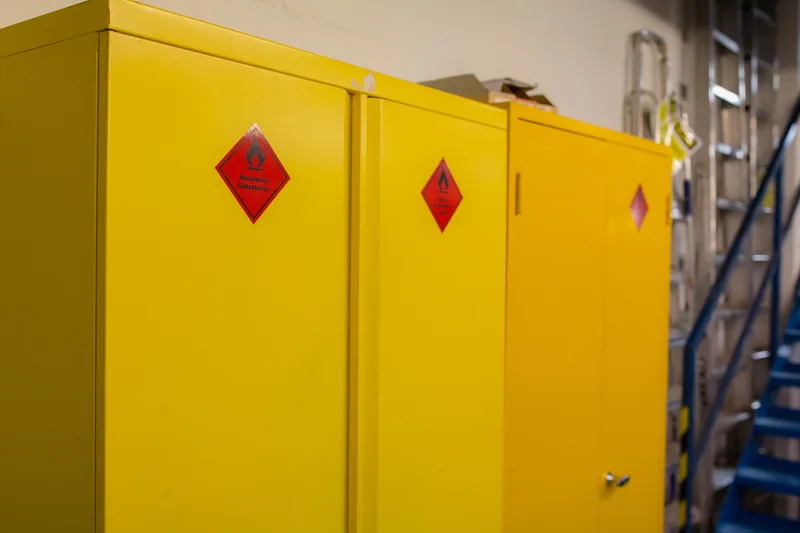
Flammable liquid in a working lab falls under the Dangerous Substances and Explosive Atmospheres Regulations, which require employers to assess and control the risks. In most labs, this means limiting the quantity kept on the bench, using a suitable flammables cabinet and keeping ignition sources away. An uncollected row of full carboys under a bench is a common finding, and it is the point of regular collections. Your waste volumes will tell you how often that needs to be.
Transport brings its own requirements. Solvents are generally class 3 flammable liquids under the dangerous goods rules, and halogenated solvents may fall under other classes. The carrier confirms what transport packaging is needed, and you remain responsible for storing, describing and presenting the waste properly until it is collected. Very often, that means transferring small bottles into a lab pack or keeping carboys in approved outer containers, so tell us what size and type you have.
Solvent-contaminated solids
Waste solvent is not always liquid. Wipes, gloves, spent silica from columns, drying agents and absorbents used on small spills all hold solvent. Keep them in a closed, labelled container and not in an open bench bin, where they will fume into the room and add to the fire load. Silica gel from chromatography may contain a mix of compounds, and it should be described with that in mind. Rags soaked in some solvents and oils can also heat up, so keep them away from ignition sources and do not pack them tightly in a sealed bag beside a heat source.
Related chemicals
Search the chemical database- AcetoneCAS 67-64-1Flammable

- EthanolCAS 64-17-5Flammable
- MethanolCAS 67-56-1Flammable


- IsopropanolCAS 67-63-0Flammable
- XyleneCAS 1330-20-7Flammable
- TolueneCAS 108-88-3Flammable
- DichloromethaneCAS 75-09-2Toxic
- ChloroformCAS 67-66-3Toxic
Frequently asked questions
Why does it matter if a little dichloromethane gets into the non-halogenated waste?
It changes the whole container. Non-halogenated solvent may be suitable for recovery or fuel use, while halogenated waste generally needs a more specialised route. A small amount of the wrong solvent can therefore change the route, and the description has to say it is there.
How full should a waste solvent container be?
Not completely. Leave headspace so that vapour expansion cannot strain the container, following your supplier's guidance and your own risk assessment. A container that is full to the neck on a cool morning can bulge or leak on a warm afternoon.
Can we evaporate small amounts in a fume cupboard rather than collecting them?
No. A fume cupboard is there to protect the user during work. It is not a means of disposal, and evaporating waste sends it straight into the air. Collect it in a labelled container.
Is used solvent always hazardous waste?
Mostly, yes. Waste solvents are listed with hazardous codes such as 14 06 02* and 14 06 03*. A laboratory might use a different entry for some material, and the assessment should take account of what the used solvent has picked up.
Can we reuse the empty solvent bottles for waste?
Yes, as long as they are clean, compatible, and have had the old label defaced and a new waste label added. Do not use a bottle that has held an oxidiser, and be careful with acid bottles. Do not use food or drink containers.
Official sources
Send us your list
A rough list or a photo of the shelf is enough for us to start. We reply within 2 working days.
Latest articles
All guides and articles-
What to do with unlabelled bottles in a lab
Do not open or move them. How to make an unlabelled bottle safe to leave, what to record and how identification works.
-
What counts as hazardous waste in a school or lab
Which lab and school waste is hazardous, how to tell, and what the law expects you to do before anything leaves site.
-
How to keep a chemical inventory in a science department
What to record for each container, how to set up locations and how to keep a school chemical register current.