
Benzene (CAS 71-43-2): storage and disposal
Benzene is a highly flammable aromatic hydrocarbon and a known human carcinogen. With no normal teaching use now, a school or college bottle is usually legacy stock from an old cupboard, while universities may hold it as a reference standard. Handling comes down to the cancer and fire hazards together with the state of the seal, and the sensible aim is to get it off site rather than keep it.
- CAS number
- 71-43-2
- Form
- Liquid
- Storage class
- Flammable
- Signal word
- Danger
- Usual EWC code, laboratory stock
- 16 05 06*
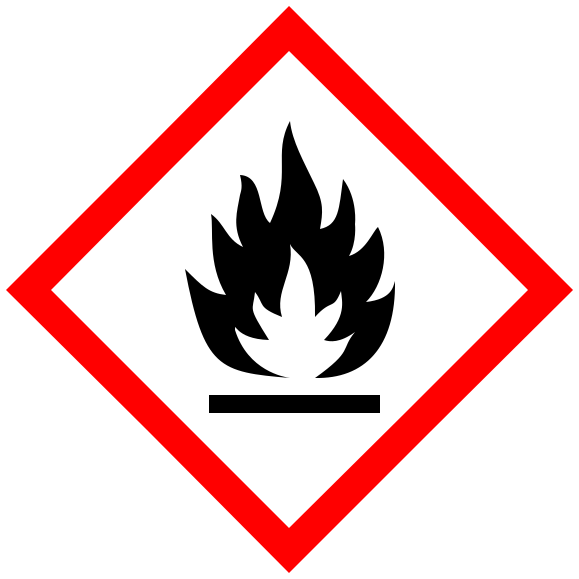 Flammable
 Harmful or irritant
 Serious health hazard
What to do this week
- Without moving anything that looks damaged, check the label is readable and write down the opened date if it is not already there.
- Check it is stored as flammable stock, and apart from anything listed under "Do not store with" on this page. If nothing is listed, that does not prove it is safe with everything.
- If you no longer need it, add it to your disposal list so it can be included in a collection.
Safe storage in a school or lab
In a school it usually turns up at the back of an old chemical cupboard, often with a worn label and no date. A sound bottle belongs in a ventilated fire-resistant cabinet with spill containment, away from ignition sources, oxidisers, oxidising acids and corrosive stock. If the seal has failed, leave it where it is and ask for advice before anyone carries it through the building. Repeated exposure damages organs and it may cause cancer and genetic defects, so nothing about keeping it near people is routine. It solidifies in a cold store, which is no reason to warm it. University reference standards may be weaker solutions with their own label wording, so go by what the label says. Any refrigerator holding it must be spark-free.
How to tell it has deteriorated
A faded label or staining on the shoulder is usually the first thing seen, because the liquid itself changes very little. Benzene gives few visual signs of age, and an old clear bottle is no weaker or safer than a new one. A white solid in a cold store is freezing, not decay. The sign that matters is a failed seal, which is common on legacy bottles because benzene softens rubber and many plastics. Look for a perished liner, a level lower than expected or a sweet solvent smell in the cupboard, which means vapour is escaping. Check from the outside only. Nobody should open or sniff it, and a bottle in that state should stay put, with the area kept clear, until a specialist has advised.
How it is disposed of
We arrange this by specialist collection. We do not publish a drain or general waste route for any chemical. It is normally packed in a flammable laboratory pack with compatible chemicals.
Leaving it to evaporate in a fume cupboard is forbidden, and it must never go into a sink, a drain, a general waste bin or a skip. Nobody should try to treat it first, or decant it into a fresh bottle because the old label or cap looks poor. Specialist collection is the only route. Name it plainly as benzene when listing it, since a bottle described vaguely as old solvent will not be grouped or planned for correctly. Say whether it is legacy neat liquid or a reference standard, give the size, and describe the seal and label. The code is usually 16 05 06*, or 16 05 08* for a discarded organic chemical outside a lab pack. A consignment note goes with it, or the special waste form in Scotland, so keep your copy on file.
| Usual EWC code, laboratory stock | 16 05 06* |
|---|---|
| Discarded organic chemical, not a laboratory pack | 16 05 08* |
| Usually classed as hazardous waste | Yes |
20 01 13* (solvents) belongs to municipal collections and is shown for reference only. It is not the normal code for a laboratory collection.
The code depends on where the waste came from and what it contains, and classifying it is the producer's duty. Use the waste code finder to see why.
Do not store with
- OxidiserOxidisers can ignite flammable materials or make a fire far more intense.
- AcidSome acids, especially oxidising acids, can ignite flammable materials, and acid fumes attack containers and seals.
- CorrosiveA leak of corrosive stock can break down flammable containers and feed a fire.
Named chemicals to keep apart
- Acetic acidOxidising acids can ignite flammable materials, and acid fumes attack containers and seals.
- Calcium hypochloriteOxidisers can ignite flammable materials or make a fire far more intense.
- Hydrochloric acidOxidising acids can ignite flammable materials, and acid fumes attack containers and seals.
- Hydrogen peroxideOxidisers can ignite flammable materials or make a fire far more intense.
- Nitric acidOxidising acids can ignite flammable materials, and acid fumes attack containers and seals.
- Potassium nitrateOxidisers can ignite flammable materials or make a fire far more intense.
- Potassium permanganateOxidisers can ignite flammable materials or make a fire far more intense.
- Sulfuric acidOxidising acids can ignite flammable materials, and acid fumes attack containers and seals.
Show 2 more
- Thionyl chlorideA leak of corrosive stock can break down flammable containers and feed a fire.
- Zinc chlorideA leak of corrosive stock can break down flammable containers and feed a fire.
Common quantities
Usually held as: legacy stock, reference standard.
Tell us the container size and how many you hold. An estimate is enough to start with, and some items cannot be priced until someone has looked at them.
Where it is commonly held
Hazard statements
- H225 Highly flammable liquid and vapour.
- H304 May be fatal if swallowed and enters airways.
- H315 Causes skin irritation.
- H319 Causes serious eye irritation.
- H340 May cause genetic defects.
- H350 May cause cancer.
- H372 Causes damage to organs through prolonged or repeated exposure.
Precautionary statements
- P203 Obtain, read and follow all safety instructions before use.
- P210 Keep away from heat, hot surfaces, sparks, open flames and other ignition sources. No smoking.
- P233 Keep container tightly closed.
- P240 Ground and bond container and receiving equipment.
- P241 Use explosion-proof electrical, ventilating and lighting equipment.
- P242 Use non-sparking tools.
- P243 Take action to prevent static discharges.
- P260 Do not breathe dust, fume, gas, mist, vapours or spray.
- P264 Wash hands and exposed skin thoroughly after handling.
- P264+P265 Wash hands and exposed skin thoroughly after handling. Do not touch eyes.
- P270 Do not eat, drink or smoke when using this product.
- P280 Wear protective gloves, protective clothing, eye protection and face protection.
- P301+P316 IF SWALLOWED: Get emergency medical help immediately.
- P302+P352 IF ON SKIN: Wash with plenty of water.
- P303+P361+P353 IF ON SKIN (or hair): Take off immediately all contaminated clothing. Rinse skin with water or shower.
- P305+P351+P338 IF IN EYES: Rinse cautiously with water for several minutes. Remove contact lenses, if present and easy to do. Continue rinsing.
- P318 If exposed or concerned, get medical advice.
- P319 Get medical help if you feel unwell.
- P321 Specific treatment (see supplemental first aid instruction on this label).
- P331 Do NOT induce vomiting.
- P332+P317 If skin irritation occurs: Get medical help.
- P337+P317 If eye irritation persists: Get medical help.
- P362+P364 Take off contaminated clothing. And wash it before reuse.
- P370+P378 In case of fire: Use suitable extinguishing media to extinguish.
- P403+P235 Store in a well-ventilated place. Keep cool.
- P405 Store locked up.
- P501 Dispose of contents and container in accordance with local, regional, national and international regulations.
Substance as classified, dilutions may differ.
Questions
We found old benzene in the prep room. Should we keep it for a demonstration?
No. It has no normal teaching use now, and it is a known human carcinogen as well as highly flammable. Record what you found, leave it closed, and arrange a specialist collection. Holding on to it just adds to what the next technician inherits.
The cap on our benzene is perished. Can we move it into a new bottle?
Do not transfer it. Doing so exposes you to vapour from a substance that may cause cancer and genetic defects, and it is highly flammable. Leave the bottle where it stands, keep people away from that cupboard, describe the failed cap when you ask for advice, and let a specialist decide how it travels.
Our benzene bottle has gone solid. Is it damaged?
It solidifies in a cold store, so a solid bottle usually means only that the room is cool. Do not warm it or carry it somewhere warmer to thaw. Check for a cracked container or failed seal from the outside, and report the state of the bottle when arranging collection.
Does a reference standard count the same as a neat bottle?
A standard held as a weak solution may be classified differently from pure benzene, though it should never be assumed safe. Go by the supplier label and safety data sheet for that item, and list it separately from any neat stock so it is described correctly for collection.
Related chemicals
Search the chemical database- 1,2-DichloroethaneCAS 107-06-2Flammable
- 1,2-DimethoxyethaneCAS 110-71-4Flammable
- 1,4-DioxaneCAS 123-91-1Flammable
- 2,4-DinitrophenylhydrazineCAS 119-26-6Flammable
- 2-Bromo-2-methylpropaneCAS 507-19-7Flammable
- 2-Chloro-2-methylpropaneCAS 507-20-0Flammable