
Argon (CAS 7440-37-1): storage and disposal
Argon is held in cylinders in university laboratories, usually to feed glove boxes, instruments and welding work where air must be excluded. It is a gas under pressure that may explode if heated, and a leak in a closed or low lying space can displace oxygen and cause asphyxiation with little or no warning. As a noble gas it does not react or age in any meaningful way, so the state and ownership of the cylinder decide how it is handled.
- CAS number
- 7440-37-1
- Form
- Gas
- Storage class
- General
- Signal word
- Warning
- Usual EWC code
- 16 05 05
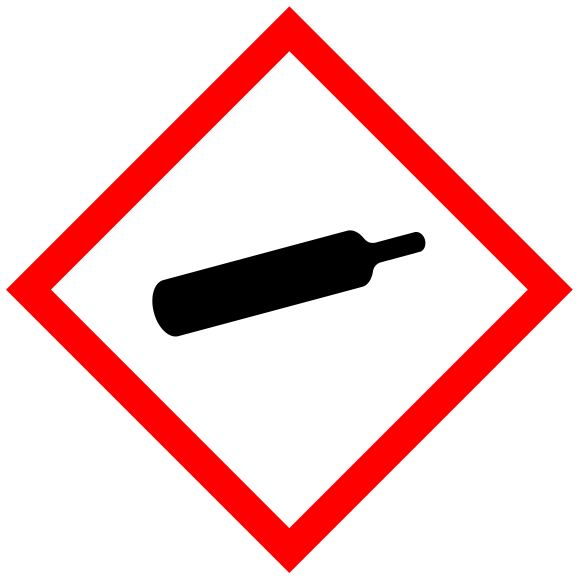 Gas under pressure
This chemical is a manual enquiry
This is a gas held under pressure, liquefied or in solid or cryogenic form. Cylinders and dewars are usually returned to the supplier or handled separately, and they do not go into a laboratory pack.
Held as a compressed or liquefied gas in a pressure container.
It cannot be priced through a form. Please do not open or move it. Call us or send an enquiry and we will talk through the next step, which depends on what it is. Keep following your own procedures for controlled drugs, radioactive materials, gases and asbestos.
What to do this week
- Leave it where it is. If it looks old, crystalline or damaged, do not open or move it and keep people away from the shelf. If there is immediate danger, such as a leak, fumes or a fire, leave the area and call 999.
- Write down the label wording, the rough age and where it is stored, from a safe distance.
- Send us those details, and a photo if you can take one without touching it.
Safe storage in a school or lab
On a university site it generally stands next to the glove box or instrument it feeds, chained to a wall bracket, and often with a second spare nearby. Spare cylinders are where standards slip. Each one needs to be upright and secured, with its valve guard on, and clear of ovens, radiators and direct sun. Research groups often leave cylinders behind when they move, and a corner of a shared store can collect several with no clear owner. Give each a tag showing the group responsible and the date it arrived, so the rental can be tracked and the cylinder can go back. Do not puncture or vent one to tidy up, and never strip a regulator from a cylinder you are unsure about.
How to tell it has deteriorated
Age does nothing to argon. It is a noble gas that does not react or break down, so a cylinder from years ago may hold exactly what it did on delivery. The changes worth looking for are on the steel and the fittings. Rust at the foot, dents, a bent valve and a missing guard are the common ones. A worn supplier label may also leave it impossible to tell what is inside, and shoulder colour alone should not be used to decide. A test mark that looks very old is a reason to raise it with the owner. Any hiss around the valve suggests a leak, and because argon is heavier than air and displaces oxygen, leave the room, keep others out and report it. With a gas that shows nothing itself, the record and the label do the most useful work.
How it is disposed of
This does not go through our standard collection route. It is arranged by manual enquiry, and never goes down the drain or into general waste.
A supplier's vehicle is how it normally leaves, as cylinders generally remain the property of the gas company and go back to them. Inherited stock from a departed research group is the difficult case, since a label may name a supplier the site no longer uses. Contact them anyway. This site does not quote for pressure containers online, and they do not go in a lab pack, so where no owner can be traced, send a manual enquiry with a photograph, the label wording, the size and the location. A store assessment is recommended if there are several. Keep each one upright and secured until you have advice. Do not vent or puncture any cylinder, and do not put one in a general waste bin or skip.
| Usual EWC code | 16 05 05 |
|---|---|
| Usually classed as hazardous waste | No |
Gases in pressure containers are assessed by manual enquiry, usually with return to the cylinder owner.
The code depends on where the waste came from and what it contains, and classifying it is the producer's duty. Use the waste code finder to see why.
Common quantities
Usually held as: cylinder.
Tell us the container size and how many you hold. An estimate is enough to start with, and some items cannot be priced until someone has looked at them.
Where it is commonly held
Hazard statements
- H280 Contains gas under pressure; may explode if heated.
Precautionary statements
- P282 Wear cold insulating gloves and either face shield or eye protection.
- P336+P317 Thaw frosted parts with lukewarm water. Do not rub affected area. Get medical help.
- P403 Store in a well-ventilated place.
- P410+P403 Protect from sunlight. Store in a well-ventilated place.
Substance as classified, dilutions may differ.
Questions
Our departed research group left six cylinders behind. Where do we start?
List each cylinder with its label, size, condition and location, then contact the supplier named on it, even if the account has closed. Most can go back that way. Anything with no traceable owner goes into a manual enquiry, with a photograph of each.
Does argon go off if a cylinder is many years old?
The gas does not break down or react. An old cylinder raises questions about its steel, valve and test mark, and not about what is inside. Treat it as a pressure container in unknown condition, keep it secured and raise it with the owner.
Can we run a spare cylinder down through the glove box to finish it off?
Do not empty a cylinder just to get rid of it. Normal use for real work is one thing, but venting or running it down has no purpose, because cylinders go back part full. Close the valve and ask the owner to collect it.
Related chemicals
Search the chemical database- 1,1,1-TrichloroethaneCAS 71-55-6General

- 1-NaphtholCAS 90-15-3General

- 2-NaphtholCAS 135-19-3General

- 3,3',5,5'-TetramethylbenzidineCAS 54827-17-7General
- 4-NitrophenolCAS 100-02-7General

- AcetophenoneCAS 98-86-2General