
Glyceryl trinitrate (CAS 55-63-0): storage and disposal
Glyceryl trinitrate, also called GTN or nitroglycerin, is held by pharmacies and clinics as sublingual tablets, spray and injection for angina. The substance itself is classified as an unstable explosive with a mass explosion hazard, and is fatal if swallowed, inhaled or in contact with skin. Medicines contain small proportions of it and may be far less hazardous than this, yet the classification is why this site takes no online quotes. What matters most is the form and condition of each item.
- CAS number
- 55-63-0
- Form
- Solid
- Storage class
- Flammable
- Signal word
- Danger
- Usual EWC code
- 16 05 06*
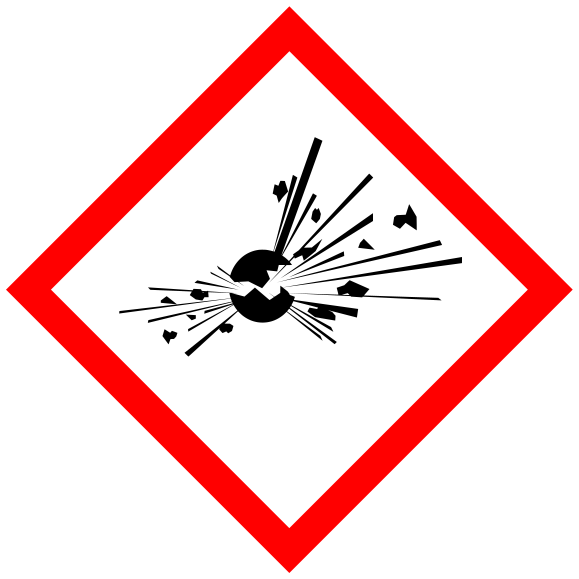 Explosive
 Acute toxicity
 Serious health hazard
 Hazardous to the environment
This chemical is a manual enquiry
This can become unstable or explosive, especially if it is old or has dried out. Nobody should move it until someone competent has looked at it, so we start with a conversation and usually a store assessment.
H code rule: H200, H201.
It cannot be priced through a form. Please do not open or move it. Call us or send an enquiry and we will talk through the safe next step, which is often a store assessment.
What to do this week
- Leave it where it is. If it looks old, crystalline or damaged, do not open or move it and keep people away from the shelf.
- Write down the label wording, the rough age and where it is stored, from a safe distance.
- Send us those details, and a photo if you can take one without touching it.
Safe storage in a school or lab
Heat, ignition sources, oxidisers, acids and corrosive stock must stay away from glyceryl trinitrate, because of its explosive classification and because a leak or fire nearby could make any incident worse. A fire-resistant cabinet is the class expectation for bulk material, while medicines normally stay in their pharmacy packaging. Tablets are the fussy form: the drug slowly escapes as vapour and can be taken up by plastics, so they are supplied in glass with a tight cap and should remain there, never transferred to a pill organiser or plastic pot. Sprays should be kept upright and away from warm sills, and should not be punctured. Keep ampoules in their carton, in a cool, locked place.
How to tell it has deteriorated
Age changes medicinal GTN quietly. Sublingual tablets lose strength because the drug escapes as vapour once a bottle has been opened, yet they look almost the same as fresh ones, so appearance is a poor guide. A crumbling tablet, staining on the glass or damage to the cap may be visible. Sprays give few signs other than a stiff valve or a pack that feels light. Bulk or laboratory GTN is entirely different. Any oily beads, crystals around a closure, seeping or a very old container is a warning sign: do not touch or move it, clear people from the area and raise an urgent alarm so that specialist assessment can be arranged.
How it must be disposed of
This does not go through our standard collection route. It is arranged by manual enquiry, and never goes down the drain or into general waste.
Removal starts with a manual enquiry, as this stock is not quoted online and an explosive or unstable item may need assessing in person by a competent chemist. If a warning sign is present, an explosives or emergency specialist may be needed. Do not open it, move it or try to make it safe, and nothing goes into a sink, bin or drain while you wait. For routine pharmacy packs, say what the pack is, how many there are and whether it has been opened, as that tells the assessor a lot. Finished medicines in human healthcare usually take 18 01 09. Anything unlabelled, or from a research store, should be mentioned up front. A store assessment is recommended.
| EWC code, laboratory chemicals | 16 05 06* |
|---|---|
| Discarded organic chemical, not a laboratory pack | 16 05 08* |
| Human healthcare setting | 18 01 09 |
| Hazardous waste | Yes |
The code depends on where the waste came from and what it is mixed with. Use the waste code finder to see why.
Do not store with
- OxidiserOxidisers can ignite flammable materials or make a fire far more intense.
- AcidOxidising acids can ignite flammable materials, and acid fumes attack containers and seals.
- CorrosiveA leak of corrosive stock can break down flammable containers and feed a fire.
Named chemicals to keep apart
- Acetic acidOxidising acids can ignite flammable materials, and acid fumes attack containers and seals.
- Calcium hypochloriteOxidisers can ignite flammable materials or make a fire far more intense.
- Hydrochloric acidOxidising acids can ignite flammable materials, and acid fumes attack containers and seals.
- Hydrogen peroxideOxidisers can ignite flammable materials or make a fire far more intense.
- Nitric acidOxidising acids can ignite flammable materials, and acid fumes attack containers and seals.
- Potassium nitrateOxidisers can ignite flammable materials or make a fire far more intense.
- Potassium permanganateOxidisers can ignite flammable materials or make a fire far more intense.
- Sulfuric acidOxidising acids can ignite flammable materials, and acid fumes attack containers and seals.
Show 2 more
- Thionyl chlorideA leak of corrosive stock can break down flammable containers and feed a fire.
- Zinc chlorideA leak of corrosive stock can break down flammable containers and feed a fire.
Common quantities we collect
Usually held as: tablets, spray, injection.
Part-used bottles and full containers are both fine. Tell us the size and how many, and an estimate is enough for a first price.
Where it is commonly held
Hazard statements
- H200 Unstable explosive.
- H201 Explosive; mass explosion hazard.
- H300 Fatal if swallowed.
- H310 Fatal in contact with skin.
- H330 Fatal if inhaled.
- H373 May cause damage to organs through prolonged or repeated exposure.
- H411 Toxic to aquatic life with long lasting effects.
Precautionary statements
- P210 Keep away from heat, hot surfaces, sparks, open flames and other ignition sources. No smoking.
- P230 Keep wetted with the specified agent.
- P240 Ground and bond container and receiving equipment.
- P250 Do not subject to grinding, shock or friction.
- P260 Do not breathe dust, fume, gas, mist, vapours or spray.
- P262 Do not get in eyes, on skin, or on clothing.
- P264 Wash hands and exposed skin thoroughly after handling.
- P270 Do not eat, drink or smoke when using this product.
- P271 Use only outdoors or in a well-ventilated area.
- P273 Avoid release to the environment.
- P280 Wear protective gloves, protective clothing, eye protection and face protection.
- P284 In case of inadequate ventilation wear respiratory protection.
- P301+P316 IF SWALLOWED: Get emergency medical help immediately.
- P302+P352 IF ON SKIN: Wash with plenty of water.
- P304+P340 IF INHALED: Remove person to fresh air and keep comfortable for breathing.
- P316 Get emergency medical help immediately.
- P319 Get medical help if you feel unwell.
- P320 Specific treatment is urgent (see supplemental first aid instruction on this label).
- P321 Specific treatment (see supplemental first aid instruction on this label).
- P330 Rinse mouth.
- P361+P364 Take off immediately all contaminated clothing. And wash it before reuse.
- P370+P380 In case of fire: Evacuate area.
- P372 Explosion risk.
- P373 DO NOT fight fire when fire reaches explosives.
- P391 Collect spillage.
- P401 Store in accordance with local, regional, national and international regulations.
- P403+P233 Store in a well-ventilated place. Keep container tightly closed.
- P405 Store locked up.
- P501 Dispose of contents and container in accordance with local, regional, national and international regulations.
- P201 Obtain special instructions before use.
- P202 Do not handle until all safety precautions have been read and understood.
- P281 Use personal protective equipment as required.
- P380 Evacuate area.
Substance as classified, dilutions may differ.
Questions
Is an expired box of GTN spray likely to explode?
The explosive classification describes the substance, and medicinal sprays and tablets contain small proportions of it, so they do not carry the same danger as bulk material. They still go through a manual enquiry. Keep the sprays upright, away from heat, and do not puncture or vent them.
Why do GTN tablets have to stay in the original glass bottle?
The drug slowly escapes as vapour and can pass into plastics, so moving tablets to another container can quickly weaken them. For stock awaiting disposal, the original bottle also preserves the label, batch and date. Those details are what an assessor needs, so nobody should transfer or mix them.
We found a very old bottle marked nitroglycerin in a lab. What do we do?
Leave it exactly where it is and do not open it. Keep people away and tell your safety lead straight away, describing the bottle from a distance. It could need a competent chemist or an explosives specialist, so send details by manual enquiry, or call the emergency services if a warning sign is present.
Related chemicals
Search the chemical database- 1,2-DichloroethaneCAS 107-06-2Flammable

- 1,2-DimethoxyethaneCAS 110-71-4Flammable
- 1,4-DioxaneCAS 123-91-1Flammable
- 2,4-DinitrophenylhydrazineCAS 119-26-6Flammable
- 2-Bromo-2-methylpropaneCAS 507-19-7Flammable
- 2-Chloro-2-methylpropaneCAS 507-20-0Flammable