
tert-Butyl methyl ether (CAS 1634-04-4): storage and disposal
tert-Butyl methyl ether, often shortened to MTBE, is a highly flammable solvent with a distinctive smell. College and university labs hold it as a neat extraction solvent, frequently as a substitute for diethyl ether. It also causes skin irritation. Unlike the ethers around it on the shelf, it is not listed as a peroxide former, so fire risk and accurate description decide handling, not the alarm the word ether can cause.
- CAS number
- 1634-04-4
- Form
- Liquid
- Storage class
- Flammable
- Signal word
- Danger
- Usual EWC code, laboratory stock
- 16 05 06*
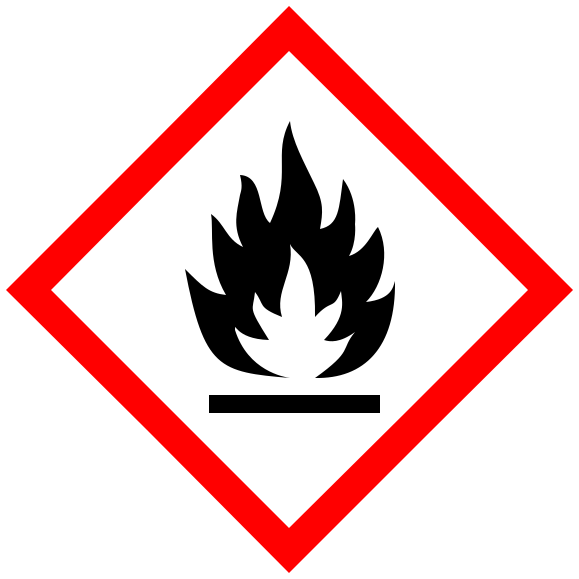 Flammable
 Harmful or irritant
What to do this week
- Without moving anything that looks damaged, check the label is readable and write down the opened date if it is not already there.
- Check it is stored as flammable stock, and apart from anything listed under "Do not store with" on this page. If nothing is listed, that does not prove it is safe with everything.
- If you no longer need it, add it to your disposal list so it can be included in a collection.
Safe storage in a school or lab
On a college shelf it usually sits in the flammables cabinet beside diethyl ether, and that closeness causes confusion when bottles are reviewed. Label it clearly, as the same abbreviated name on a hand-written label could be read as a far more dangerous ether. Its place is a ventilated fire-resistant cabinet with spill containment, clear of ignition sources, with oxidisers and corrosive stock elsewhere. Strong acids deserve particular distance, since they break the ether apart and give off flammable gas, on top of the fire risk they already add. A volatile skin irritant does not suit an open tray on a bench, even for a short practical. Any cold storage needs a spark-free refrigerator.
How to tell it has deteriorated
Ageing is uneventful here: its structure resists the slow reaction with air that troubles other ethers, and it is not listed as a peroxide former. Clear, colourless liquid is what you should see, and it gives few visual signs however long it stands. So the useful checks are about the bottle. Look for a reduced level from a poor seal, a softened or leaking cap, staining around the neck and a label too faded to read. A clearly different colour or a thick residue would mean something else got in. That matters most when a label has gone, because an unidentified ether cannot be assumed to be this one, and an unknown bottle should stay closed until a specialist has seen it.
How it is disposed of
We arrange this by specialist collection. We do not publish a drain or general waste route for any chemical. It is normally packed in a flammable laboratory pack with compatible chemicals.
A flammable ether solvent cannot go into a sink, a drain, a general waste bin or a skip, and nobody should try to treat it first. Collection by a specialist is the only way out. Its awkward point is identification: list it by its full name with any abbreviation in brackets, so it is not mistaken for a peroxide forming ether and held back. Equally, do not assume an unlabelled ether bottle is this one. Shared waste bottles are another common fault, as extraction residues contain whatever was being extracted and need listing as a mixture, separate from neat stock. Give the volume and the state of the seal. Where a consignment note is needed, keep your copy for three years.
| Usual EWC code, laboratory stock | 16 05 06* |
|---|---|
| Discarded organic chemical, not a laboratory pack | 16 05 08* |
| Usually classed as hazardous waste | Yes |
20 01 13* (solvents) belongs to municipal collections and is shown for reference only. It is not the normal code for a laboratory collection.
The code depends on where the waste came from and what it contains, and classifying it is the producer's duty. Use the waste code finder to see why.
Do not store with
- OxidiserOxidisers can ignite flammable materials or make a fire far more intense.
- AcidSome acids, especially oxidising acids, can ignite flammable materials, and acid fumes attack containers and seals.
- CorrosiveA leak of corrosive stock can break down flammable containers and feed a fire.
Named chemicals to keep apart
- Acetic acidOxidising acids can ignite flammable materials, and acid fumes attack containers and seals.
- Calcium hypochloriteOxidisers can ignite flammable materials or make a fire far more intense.
- Hydrochloric acidOxidising acids can ignite flammable materials, and acid fumes attack containers and seals.
- Hydrogen peroxideOxidisers can ignite flammable materials or make a fire far more intense.
- Nitric acidOxidising acids can ignite flammable materials, and acid fumes attack containers and seals.
- Potassium nitrateOxidisers can ignite flammable materials or make a fire far more intense.
- Potassium permanganateOxidisers can ignite flammable materials or make a fire far more intense.
- Sulfuric acidOxidising acids can ignite flammable materials, and acid fumes attack containers and seals.
Show 2 more
- Thionyl chlorideA leak of corrosive stock can break down flammable containers and feed a fire.
- Zinc chlorideA leak of corrosive stock can break down flammable containers and feed a fire.
Common quantities
Usually held as: neat.
Tell us the container size and how many you hold. An estimate is enough to start with, and some items cannot be priced until someone has looked at them.
Where it is commonly held
Hazard statements
- H225 Highly flammable liquid and vapour.
- H315 Causes skin irritation.
Precautionary statements
- P210 Keep away from heat, hot surfaces, sparks, open flames and other ignition sources. No smoking.
- P233 Keep container tightly closed.
- P240 Ground and bond container and receiving equipment.
- P241 Use explosion-proof electrical, ventilating and lighting equipment.
- P242 Use non-sparking tools.
- P243 Take action to prevent static discharges.
- P264 Wash hands and exposed skin thoroughly after handling.
- P280 Wear protective gloves, protective clothing, eye protection and face protection.
- P302+P352 IF ON SKIN: Wash with plenty of water.
- P303+P361+P353 IF ON SKIN (or hair): Take off immediately all contaminated clothing. Rinse skin with water or shower.
- P321 Specific treatment (see supplemental first aid instruction on this label).
- P332+P317 If skin irritation occurs: Get medical help.
- P362+P364 Take off contaminated clothing. And wash it before reuse.
- P370+P378 In case of fire: Use suitable extinguishing media to extinguish.
- P403+P235 Store in a well-ventilated place. Keep cool.
- P501 Dispose of contents and container in accordance with local, regional, national and international regulations.
Substance as classified, dilutions may differ.
Questions
Does tert-butyl methyl ether form peroxides like diethyl ether?
It is not listed as a peroxide former, and that is one reason labs choose it as a substitute. Even so, keep dates on the bottle as you would for any solvent. An unlabelled bottle is another matter: it could be any ether, so leave it closed and ask.
What do we do with extraction residues containing this solvent?
Keep them in their own labelled container and record what else went in. A residue is a mixture and may carry hazards the neat solvent lacks, so it should be listed separately from unused stock. Do not leave it to disappear in a fume cupboard.
Can it be stored next to our diethyl ether?
Both belong in a ventilated fire-resistant cabinet, so sharing is common. The real risk is mix-ups, as one is a serious peroxide former and this one is not. Clear full-name labels and date marks on each bottle keep reviews honest and prevent the wrong bottle being assumed safe.
Related chemicals
Search the chemical database- 1,2-DichloroethaneCAS 107-06-2Flammable

- 1,2-DimethoxyethaneCAS 110-71-4Flammable
- 1,4-DioxaneCAS 123-91-1Flammable
- 2,4-DinitrophenylhydrazineCAS 119-26-6Flammable
- 2-Bromo-2-methylpropaneCAS 507-19-7Flammable
- 2-Chloro-2-methylpropaneCAS 507-20-0Flammable