
Sodium dichloroisocyanurate (CAS 2893-78-9): storage and disposal
Disinfectant tablets and granules containing sodium dichloroisocyanurate turn up wherever surfaces are cleaned: school and college prep rooms, university and pathology labs, clinics, veterinary rooms and dental surgeries. The solid is classified as an oxidiser, harmful if swallowed, irritating to eyes and airways, and very toxic to aquatic life. Damp and the wrong neighbours are what turn a tub of tablets into a problem.
- CAS number
- 2893-78-9
- Form
- Solid
- Storage class
- Oxidiser
- Signal word
- Danger
- Usual EWC code, laboratory stock
- 16 05 06*
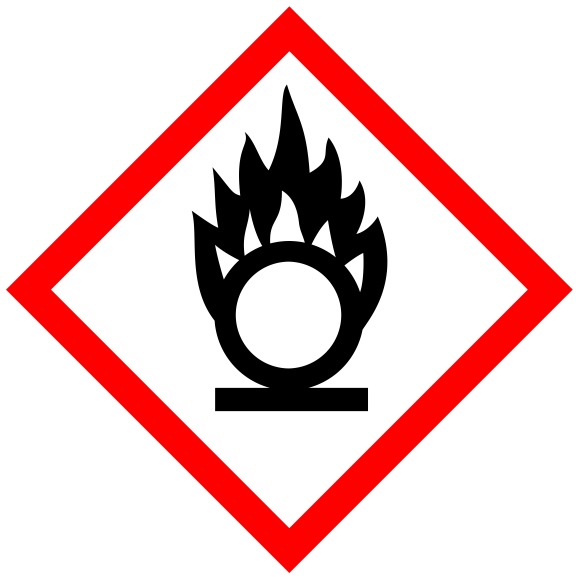 Oxidising
 Harmful or irritant
 Hazardous to the environment
What to do this week
- Without moving anything that looks damaged, check the label is readable and write down the opened date if it is not already there.
- Check it is stored as oxidiser stock, and apart from anything listed under "Do not store with" on this page. If nothing is listed, that does not prove it is safe with everything.
- If you no longer need it, add it to your disposal list so it can be included in a collection.
Safe storage in a school or lab
In a school prep room the tub of tablets is often kept with cleaning supplies under a bench, within reach of the acid descaler and the ammonia based spray. That is exactly the combination to avoid: acids and ammonia must never share space with it, nor must solvents such as acetone. Sound stock belongs in the oxidiser space on non-combustible shelving, in its original closed container protected from moisture. Do not attempt to tighten or open a container showing signs of decomposition. Separate it from flammable, alkali, toxic and corrosive stock too. Clinics, dental practices and veterinary rooms that hold tablets for surface disinfection should do the same, and avoid decanting loose tablets into unmarked pots.
How to tell it has deteriorated
Moisture is the thing that changes this substance. Tablets that have crumbled, swollen, stuck together or taken on a damp, chalky look have been exposed to air, and a sharp chlorine smell around the container may indicate decomposition or a reaction involving moisture or incompatible material. Granules clump into a hard cake. Nearby metal tends to suffer first: look for corroded caps, rust spots on the shelf, stained or lifting labels and a crust around the neck of the tub. A tub that has been topped up from several others, or has lost its label, should be recorded as it is found. If a strong chlorine smell is present, do not approach or handle the tub. Keep people away from the affected area and request specialist safety assistance.
How it is disposed of
We arrange this by specialist collection. We do not publish a drain or general waste route for any chemical. It is normally packed in an oxidising laboratory pack with compatible chemicals.
Never combine leftover tablets with acids or ammonia products, and none of it goes into a sink, a drain, a general waste bin or a skip. Staff should not try to treat or dissolve it first. The usual waste code is 16 05 06*, with 18 01 06* for a clinic or dental surgery and 18 02 05* for a veterinary practice. It is packed in an oxidiser group in a lab pack, away from acids, ammonia and flammable stock. Record whether the stock is tablets or granules, how many tubs there are, and whether any have crumbled or a chlorine smell has been noticed nearby. Do not sniff a tub to check.
| Usual EWC code, laboratory stock | 16 05 06* |
|---|---|
| Discarded organic chemical, not a laboratory pack | 16 05 08* |
| Human healthcare setting | 18 01 06* |
| Veterinary setting | 18 02 05* |
| Usually classed as hazardous waste | Yes |
The code depends on where the waste came from and what it contains, and classifying it is the producer's duty. Use the waste code finder to see why.
Do not store with
- FlammableOxidisers can ignite flammable materials or make a fire far more intense.
- AcidMany oxidisers release toxic gas or become unstable in contact with acid.
- AlkaliSome oxidisers react strongly with alkalis, and ammonia based stock is especially at risk.
- ToxicToxic and oxidising stock are stored apart. A reaction could release toxic vapours.
- CorrosiveCorrosive stock can react with oxidisers, releasing heat or fumes.
Named chemicals to keep apart
- Acetic acidMany oxidisers release toxic gas or become unstable in contact with acid.
- AcetoneChlorine releasing products react with these solvents, releasing heat and chlorinated products.
- Ammonia gasChlorine releasing products and ammonia or amines form toxic chloramines.
- Ammonia solutionChlorine releasing products and ammonia or amines form toxic chloramines.
- Ammonium chlorideChlorine releasing products and ammonia or amines form toxic chloramines.
- Ammonium nitrateChlorine releasing products and ammonia or amines form toxic chloramines.
- Ammonium sulfateChlorine releasing products and ammonia or amines form toxic chloramines.
- AnilineHypochlorites and chlorine releasing agents can react dangerously with aniline through oxidation and chlorination.
Show 23 more
- ButylamineHypochlorites and ammonia or amines form toxic chloramine gases.
- DiethylamineChlorine releasing products and ammonia or amines form toxic chloramines.
- EthanolChlorine releasing products react with these solvents, releasing heat and chlorinated products.
- EthanolamineChlorine releasing products and ammonia or amines form toxic chloramines.
- EthylenediamineHypochlorites and ammonia or amines form toxic chloramine gases.
- FormalinToxic and oxidising stock are stored apart. A reaction could release toxic vapours.
- Formic acidHypochlorites release toxic chlorine gas in contact with acids.
- HexamethylenediamineHypochlorites and ammonia or amines form toxic chloramine gases.
- HexaneOxidisers can ignite flammable materials or make a fire far more intense.
- Hydrobromic acidChlorine releasing products give off toxic chlorine or other halogen vapours in contact with this acid.
- Hydrochloric acidChlorine releasing products give off toxic chlorine gas in contact with acids.
- Hydroiodic acidChlorine releasing products give off toxic chlorine or other halogen vapours in contact with this acid.
- IsopropanolChlorine releasing products react with these solvents, releasing heat and chlorinated products.
- Mercury(II) chlorideToxic and oxidising stock are stored apart. A reaction could release toxic vapours.
- MethanolChlorine releasing products react with these solvents, releasing heat and chlorinated products.
- Nitric acidChlorine releasing products give off toxic chlorine gas in contact with acids.
- Perchloric acidChlorine releasing products give off toxic chlorine gas in contact with acids.
- Phosphoric acidChlorine releasing products give off toxic chlorine gas in contact with acids.
- PyridineHypochlorites and chlorine releasing products can react dangerously with this amine, giving toxic chlorinated products.
- Sulfuric acidChlorine releasing products give off toxic chlorine gas in contact with acids.
- Trichloroacetic acidChlorine releasing products give off toxic chlorine gas in contact with acids.
- TriethanolamineHypochlorites and chlorine releasing products can react dangerously with this amine, giving toxic chlorinated products.
- TriethylamineChlorine releasing products can react dangerously with this amine, giving toxic chlorinated products.
Common quantities
Usually held as: tablets, granules.
Tell us the container size and how many you hold. An estimate is enough to start with, and some items cannot be priced until someone has looked at them.
Where it is commonly held
Hazard statements
- H272 May intensify fire; oxidiser.
- H302 Harmful if swallowed.
- H319 Causes serious eye irritation.
- H335 May cause respiratory irritation.
- H410 Very toxic to aquatic life with long lasting effects.
- EUH031 Contact with acids liberates toxic gas.
Precautionary statements
- P210 Keep away from heat, hot surfaces, sparks, open flames and other ignition sources. No smoking.
- P220 Keep away from clothing and other combustible materials.
- P261 Avoid breathing dust, fume, gas, mist, vapours or spray.
- P264 Wash hands and exposed skin thoroughly after handling.
- P264+P265 Wash hands and exposed skin thoroughly after handling. Do not touch eyes.
- P270 Do not eat, drink or smoke when using this product.
- P271 Use only outdoors or in a well-ventilated area.
- P273 Avoid release to the environment.
- P280 Wear protective gloves, protective clothing, eye protection and face protection.
- P301+P317 IF SWALLOWED: Get medical help.
- P304+P340 IF INHALED: Remove person to fresh air and keep comfortable for breathing.
- P305+P351+P338 IF IN EYES: Rinse cautiously with water for several minutes. Remove contact lenses, if present and easy to do. Continue rinsing.
- P319 Get medical help if you feel unwell.
- P330 Rinse mouth.
- P337+P317 If eye irritation persists: Get medical help.
- P370+P378 In case of fire: Use suitable extinguishing media to extinguish.
- P391 Collect spillage.
- P403+P233 Store in a well-ventilated place. Keep container tightly closed.
- P405 Store locked up.
- P501 Dispose of contents and container in accordance with local, regional, national and international regulations.
Substance as classified, dilutions may differ.
Questions
Why can't these tablets be stored near cleaning acids?
Acids release toxic chlorine gas from chlorine releasing disinfectants, and ammonia gives toxic chloramines. Keep the tablets in their own space, not in a general cleaning cupboard alongside descalers, drain cleaners or ammonia based sprays.
A tub of tablets smells of chlorine. What should we do?
A chlorine smell may indicate decomposition or a reaction involving moisture or incompatible material. Do not approach or open the container to investigate, and do not attempt to tighten its lid. Keep people away from the affected area and obtain specialist safety assistance before arranging collection. Do not try to dry or rework the tablets.
Can a dental surgery put out-of-date tablets in clinical waste?
No. They are a chemical waste, classified as an oxidiser and very toxic to aquatic life. They go by specialist collection, not into clinical or general waste, a sink or a drain.
Do tablets and granules need separate records?
Yes. State the form, the number and size of tubs and the condition of each. Granules that have set into a cake, or tablets that have crumbled, should be recorded as deteriorated stock. Moisture exposure is one possible cause.
Related chemicals
Search the chemical database- Ammonium dichromateCAS 7789-09-5Oxidiser



- Ammonium nitrateCAS 6484-52-2Oxidiser
- Ammonium perchlorateCAS 7790-98-9Oxidiser
- Ammonium persulfateCAS 7727-54-0Oxidiser
- Barium nitrateCAS 10022-31-8Oxidiser
- Barium peroxideCAS 1304-29-6Oxidiser